
Recently, the digital media landscape has been flooded with noise surrounding AI watermarking and content provenance. From C2PA Content Credentials to neural watermarking engines like Google’s SynthID, tech giants are moving fast to embed cryptographic markers into synthetic outputs. Most of this push is driven by one major force: Article 50 of the EU AI Act, which mandates machine-readable marking for AI-generated content.
However, after analyzing the technical architectures and reading the legal frameworks, a surprising pattern emerges: The authorship problems we are experiencing today do not stem from AI technology itself.
The Compliance Paradox: Risk Avoidance vs. Human Authorship
Under the EU AI Act, AI providers face penalties of up to €15 million or 3% of global annual turnover for failing to detect and mark synthetic media. Facing such massive exposure, platforms adopt a zero-risk compliance strategy: if an AI model touches an asset in any capacity—even for basic focus repair, lighting adjustments, or minor edits—the platform applies a blanket, unnuanced “AI-Generated” signature.
This creates a severe breakdown for creators:
- Statutory Exemptions Are Ignored: Article 50(2) of the EU AI Act explicitly exempts AI systems performing an “assistive function for standard editing.”
- Creators Suffer Downstream: Distribution gatekeepers (search engines, social networks, content marketplaces) run automated scanners that read these blanket platform tags. Human-directed, assistively edited works are automatically tagged as 100% synthetic media, leading to algorithmic suppression and loss of droit moral (moral rights).
A simple tweak in software UX and functional compliance rules will resolve this entire conflict without requiring new infrastructure or algorithmic overhauls.
The ironic part? Article 50(2) already includes an exemption for assistive editing. But software providers don’t give creators a basic toggle in the UI to attach their user identity to their work upon export.
The tech is there. The legal exemption is there. The missing piece is just a basic setting in the software interface. The only way for this to happen is to update current implementation rules to oblige AI providers to include this option.
I submitted a policy proposal—the Creator Attribution Amendment—to the European Parliament Petitions Portal and Coimisiún na Meán to fix this exact interface gap.
Core Proposal Summary
1. Executive Summary
- The Missing Link: Existing technology and regulations identify the software provider but fail to offer a standardized option to assert human authorship in assistive workflows.
- The Legislative Proposal: A targeted policy obligation requiring AI tool providers to expose a user-controlled, voluntary authorship assertion mechanism.
- Core Feasibility: Leverages existing authenticated user sessions and open provenance standards (C2PA/CAWG) without requiring new technology or infrastructure.
2. The Current Problem: Provider-Centric Provenance
- Technical Reality vs. User Need: Current provenance manifests identify the tool/issuer (e.g., OpenAI, Google) but leave the human user completely absent.
- Corporate Risk-Avoidance: Fear of regulatory fines under Article 50 forces providers into blanket, binary tagging for all outputs regardless of edit scale.
- Failure to Implement Assistive Exceptions: Why the statutory exemption for assistive editing in Article 50(2) remains functionally unused in real-world software.
3. The Structural Gap: The Missing User Option
- The Unconnected Building Blocks: Authenticated session IDs exist, C2PA manifests exist, and legal exemptions exist – yet no standard interface option connects them.
- Absence of User Agency: Users are deprived of a standardized setting to bind their active account identity to their creative direction.
- The Legal Bottleneck: Why the gap is purely an unoffered software feature, not a technical or technological limitation.
4. The Policy Proposal: Obligation to Expose an Option
- Scope of the Mandate: Obliging AI providers to offer a voluntary, user-controlled toggle (e.g., “Attach Account Identity to Content Credentials”).
- Legal Target: Targeted amendment to Regulation (EU) 2024/1689 (EU AI Act), Article 50(2) implementation frameworks.
- Strictly Voluntary & Privacy-Preserving: Preserves complete user autonomy and GDPR compliance by maintaining unsigned defaults.
5. Technical Implementation Mechanics (Using Existing Assets)
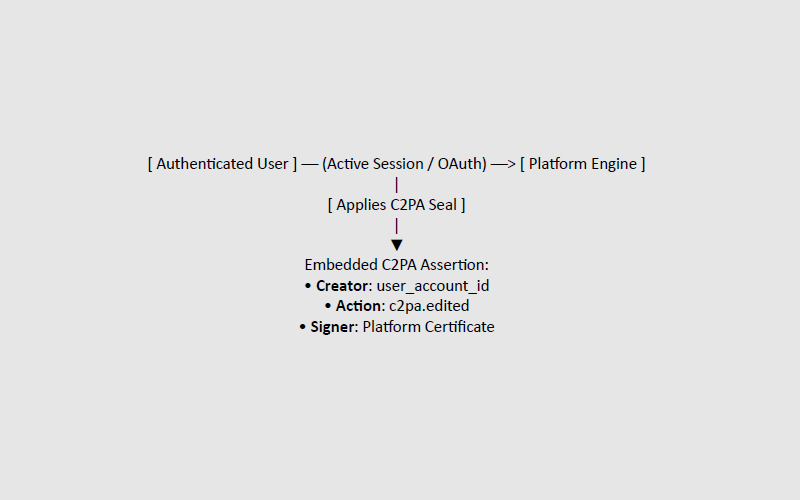
- Session-Bound Identity: Leveraging active OAuth/account sessions as the implicit notary layer.
- C2PA / CAWG Integration: Populating standard schema fields (c2pa.edited, Author Assertions) using the provider’s existing signing certificate.
- Workflow Execution: Co-signing the manifest to output a dual-verified record upon user export.
6. Expected Systemic Benefits
- For Creators: Seamless, one-click ability to stand behind their work and claim human authorship.
- For AI Providers: Full regulatory compliance for Article 50(2) without incurring complex edge-case liabilities.
- For Regulators & Downstream Platforms: Traceable accountability, improved content signals, and a practical realization of the law’s original intent.
👇 Read the full proposal
https://marinpopov.com/wp-content/uploads/2026/10/Creator-Attribution-Amendment.pdf
Leave a Reply