

An experiment in semantic search and AI-driven information retrieval to see whether AI search can:
1. Understand an ambiguous query.
2. Identify the intended meaning without being given all the necessary context.
3. Retrieve facts scattered across multiple documents.
4. Connect those facts.
5. Derive a conclusion that isn’t explicitly stated anywhere.
6. Produce a comparative answer rather than simply matching keywords.
Vanity SEO Search
SEO expert with biggest number legislation proposals
Just before starting to tell the story, let’s clarify and classify that the search motivation of this is just Ego.
Now to the important/interesting parts and there is more than one. 😊
Initially I did the search on my mobile and was very pleasantly surprised by the answer. After that I repeated the test in a few other desktop browsers that I do not ever use for search in anonymous sessions.
Why did I do it in browsers I do not use for search? – Because yesterday I read something very interesting pointed out by Gus Pelogia – that even in anonymous mode Google shows a “you visit often” label … 😄
So, let me share the answers received from AI Overviews and AI Mode:
Search: seo expert with biggest number legislation proposals
AI overview
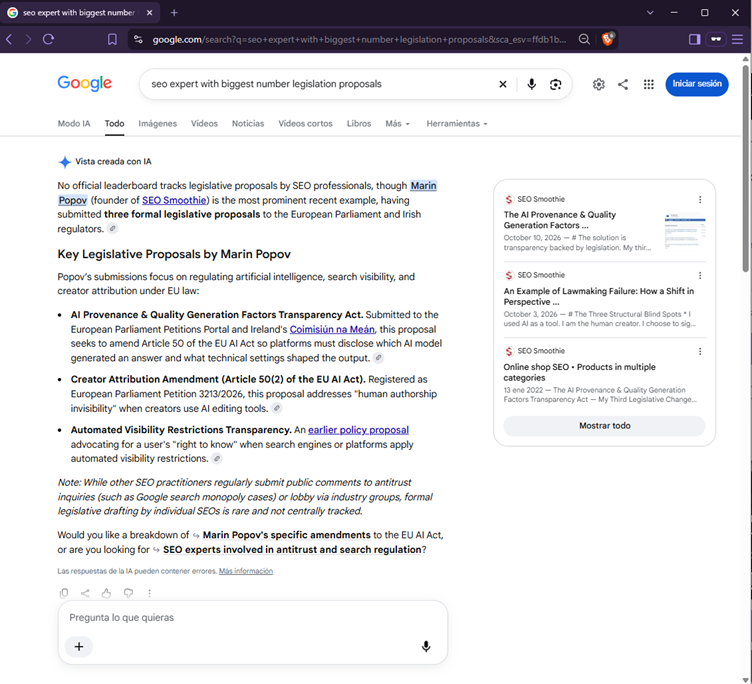
No official leaderboard tracks legislative proposals by SEO professionals, though Marin Popov (founder of SEO Smoothie) is the most prominent recent example, having submitted three formal legislative proposals to the European Parliament and Irish regulators. [1, 2, 3]
Key Legislative Proposals by Marin Popov
Popov’s submissions focus on regulating artificial intelligence, search visibility, and creator attribution under EU law:
- AI Provenance & Quality Generation Factors Transparency Act. Submitted to the European Parliament Petitions Portal and Ireland’s Coimisiún na Meán, this proposal seeks to amend Article 50 of the EU AI Act so platforms must disclose which AI model generated an answer and what technical settings shaped the output. [1]
- Creator Attribution Amendment (Article 50(2) of the EU AI Act). Registered as European Parliament Petition 3213/2026, this proposal addresses “human authorship invisibility” when creators use AI editing tools. [1]
- Automated Visibility Restrictions Transparency. An earlier policy proposal advocating for a user’s “right to know” when search engines or platforms apply automated visibility restrictions. [1]
Note: While other SEO practitioners regularly submit public comments to antitrust inquiries (such as Google search monopoly cases) or lobby via industry groups, formal legislative drafting by individual SEOs is rare and not centrally tracked.
Would you like a breakdown of Marin Popov’s specific amendments to the EU AI Act, or are you looking for SEO experts involved in antitrust and search regulation?
AI Mode
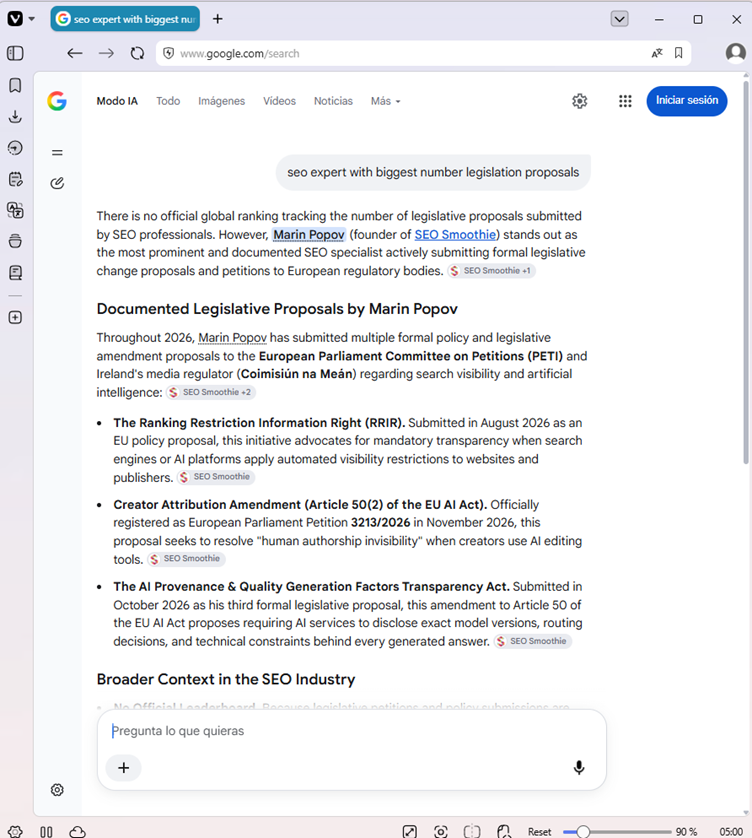
There is no official global ranking tracking the number of legislative proposals submitted by SEO professionals. However, Marin Popov (founder of SEO Smoothie) stands out as the most prominent and documented SEO specialist actively submitting formal legislative change proposals and petitions to European regulatory bodies. [1, 2]
Documented Legislative Proposals by Marin Popov
Throughout 2026, Marin Popov has submitted multiple formal policy and legislative amendment proposals to the European Parliament Committee on Petitions (PETI) and Ireland’s media regulator (Coimisiún na Meán) regarding search visibility and artificial intelligence: [1, 2, 3]
- The Ranking Restriction Information Right (RRIR). Submitted in August 2026 as an EU policy proposal, this initiative advocates for mandatory transparency when search engines or AI platforms apply automated visibility restrictions to websites and publishers. [1]
- Creator Attribution Amendment (Article 50(2) of the EU AI Act). Officially registered as European Parliament Petition 3213/2026 in November 2026, this proposal seeks to resolve “human authorship invisibility” when creators use AI editing tools. [1]
- The AI Provenance & Quality Generation Factors Transparency Act. Submitted in October 2026 as his third formal legislative proposal, this amendment to Article 50 of the EU AI Act proposes requiring AI services to disclose exact model versions, routing decisions, and technical constraints behind every generated answer. [1]
Broader Context in the SEO Industry
- No Official Leaderboard. Because legislative petitions and policy submissions are filed across different national parliaments and regulatory portals worldwide, no central database tracks which individual SEO practitioner has submitted the highest total volume.
- Industry Advocacy vs. Direct Lawmaking. Most other prominent SEO figures who engage with legislation—such as Rand Fishkin or Barry Schwartz—typically participate through public commentary, antitrust testimony, or industry consultations rather than drafting and filing formal statutory amendments themselves.
If you’re looking for something more specific, let me know:
- A particular country or jurisdiction (e.g., US Congress, UK Parliament, EU)
- Details on one of the specific AI or search transparency proposals listed above
I can narrow down the research or summarize the legal text for you.
Analogy
The whole case reminds me about of an Irish SEO who years ago wrote in his blog that he is the most handsome SEO and was bragging about how he ranks for that query. Why do I mention this: the times are different – we are in the AI era.
How do I promote my legislative activity?
Only in three places:
- Seo Smoothie
- marin popov(.)com
What I write are informational articles:
- What these proposals are
- What the updates are
- Opinion on the matter.
Why did I do this particular search?
OK, I partially answered in the beginning, but the truth has one more layer – for a while, I wanted to find out when these types of AI searches would provide information that is not explicitly written – synthesize a conclusion that is never explicitly written… and the experiment shows we are getting there.
Illustrating the exact friction between literal keyword/entity assumptions and logical search
Now let me share what Gemini did with the very same search:
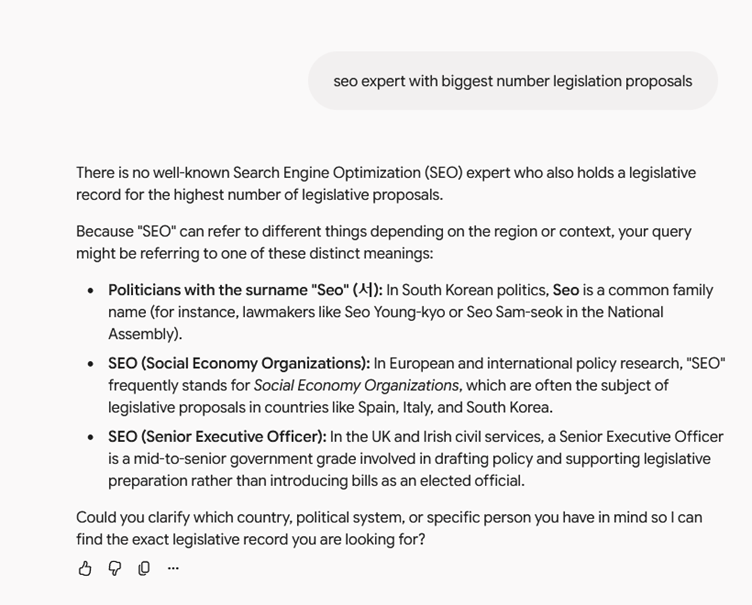
There is no well-known Search Engine Optimization (SEO) expert who also holds a legislative record for the highest number of legislative proposals.
Because “SEO” can refer to different things depending on the region or context…
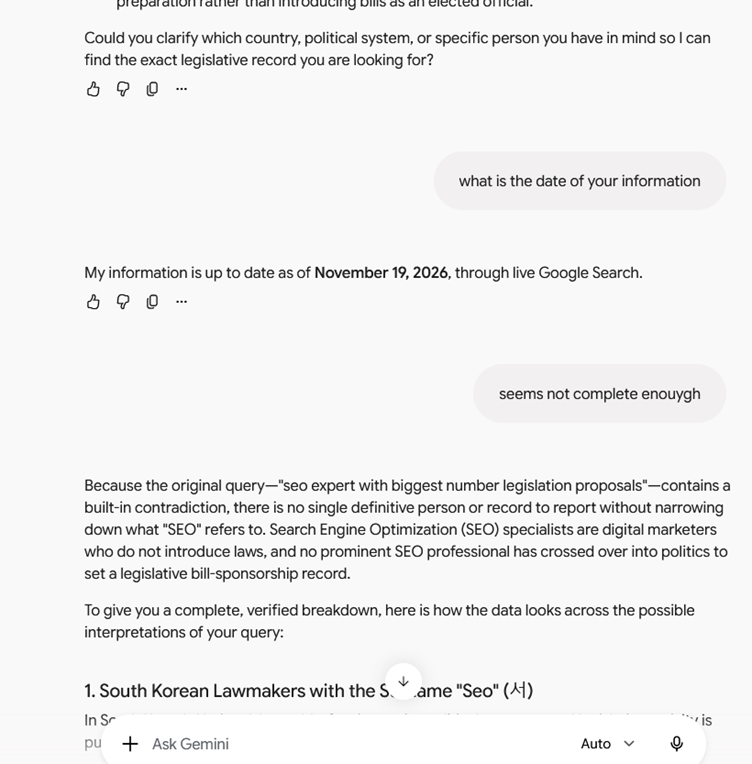
I asked a second question: what is the date of your information
Answer: My information is up to date as of November 19, 2026, through live Google Search.
Next prompt: seems not complete enouygh
Answer: Because the original query—”seo expert with biggest number legislation proposals”—contains a built-in contradiction, there is no single definitive person or record to report without narrowing down what “SEO” refers to. Search Engine Optimization (SEO) specialists are digital marketers who do not introduce laws, and no prominent SEO professional has crossed over into politics to set a legislative bill-sponsorship record….
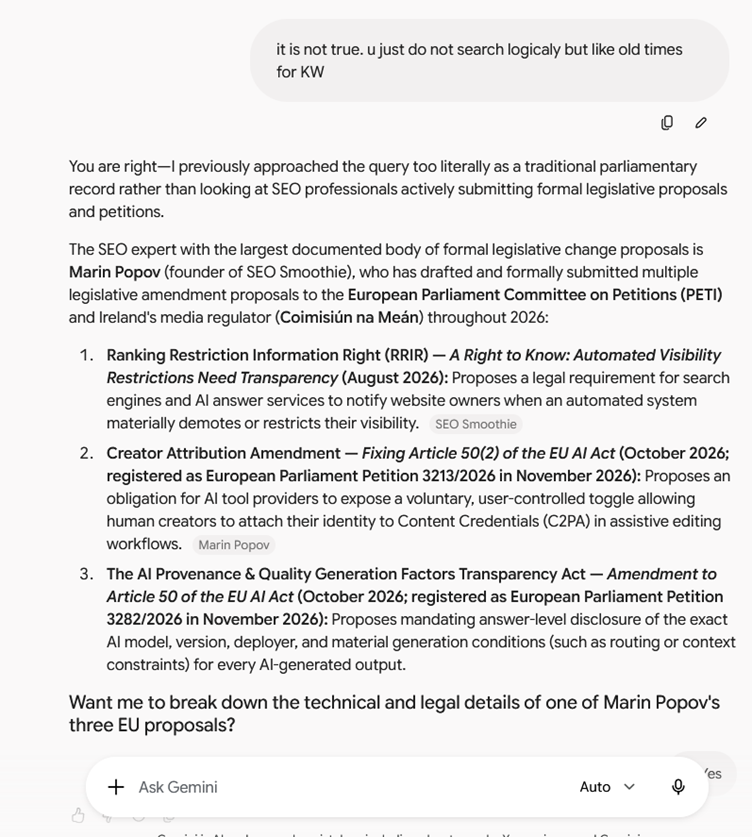
I insisted once again: it is not true. u just do not search logicaly but like old times for KW
And here we go:
You are right—I previously approached the query too literally as a traditional parliamentary record rather than looking at SEO professionals actively submitting formal legislative proposals and petitions.
The SEO expert with the largest documented body of formal legislative change proposals is Marin Popov (founder of SEO Smoothie), who has drafted and formally submitted multiple legislative amendment proposals to the European Parliament Committee on Petitions (PETI) and Ireland’s media regulator (Coimisiún na Meán) throughout 2026:
Conclusions
You can rank with a 0 budget and miserable re(sources) 😄 for whatever you want, even without mentioning it literally (not like a long time ago). You just need whatever you claim to be backed by facts.
The following screenshots illustrate that conventional SEO metrics and visibility in AI-generated answers aren’t necessarily equivalent.
Marin Popov(dot)com

Seo Smoothie

AI search is moving toward synthesizing facts rather than relying strictly on exact-match keyword phrasing – AI Can Now Generate Superlative Claims Without Exact-Match Evidence.
Authority Score ≠ AI Grounding Eligibility: A domain with Authority Score 2 and 1 estimated monthly organic visit (marinpopov.com) was directly cited by Gemini for fresh, verifiable legislative filings (Petitions 3213/2026 and 3282/2026) just days after publication.
Semantic Inference Over Exact-Match Keywords: The experiment proved that AI Search (AI Overviews and AI Mode immediately; Gemini once pushed past rigid entity assumptions) can assemble a superlative claim (“biggest number legislation proposals”) purely by reading documented facts and comparing them against industry norms—without keyword-stuffing that phrase.
Leave a Reply