
For a while, I was concerned about the quality of AI services and the lack of transparency related to the conditions under which answers are generated.
If you are curious about what I mean, you can check my book SEO Contradictions — Volume V — Perspectives.
It is free and can be found on Google Books.
· And the The AI Quality Drop: What’s Really Happening Across All Models — And Why It’s Not an Accident
· AI Degradation chapters
Or some of my LinkedIn posts related to the topic, discussing the use of offensive vocabulary as an indicator of user frustration with AI, or my opinion on Anthropic’s policy change related to abusive behaviour towards its AI.
Anyway, the main point is that it is not the AI’s fault, but rather the companies that make finance-based decisions that degrade the user experience.
The only solution is a legislative change providing clear information to the end user about what was used to create the delivered response.
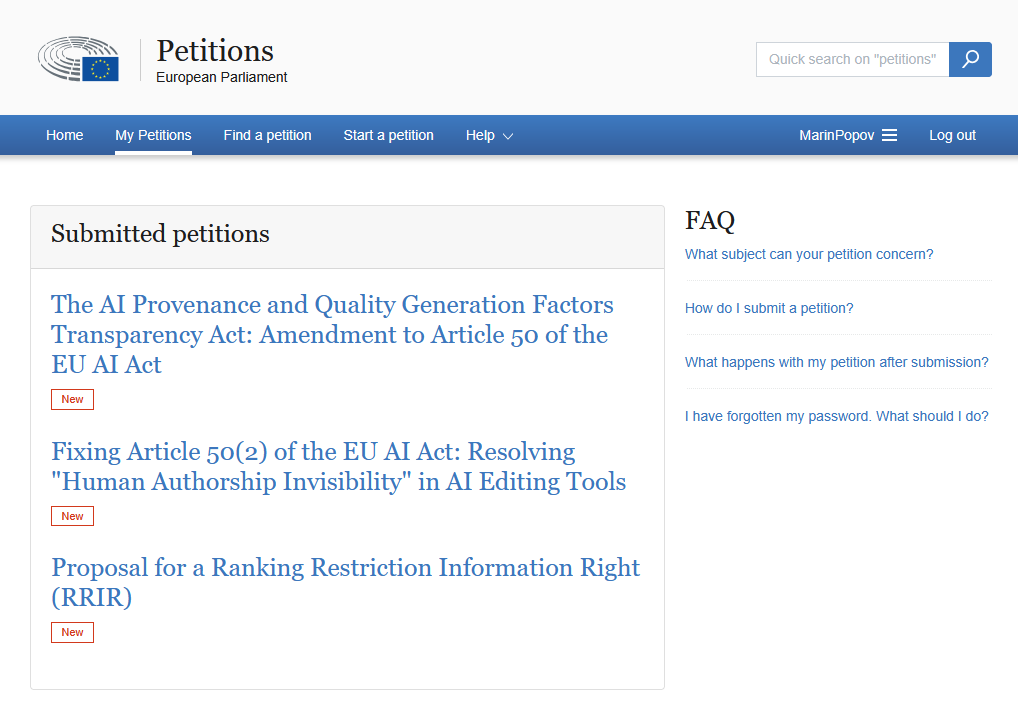
I have just submitted my third formal legislative amendment proposal to the European Parliament Petitions Portal and Coimisiún na Meán to address the issue.
The AI Provenance & Quality Generation Factors Transparency Act
Amendment to Article 50 of the EU AI Act to Guarantee Answer-Level Provenance and Technical Quality Transparency
Core Proposal Summary
1. Executive Summary & Objective
- Core Proposal: Establish an explicit legal right to Generation Transparency requiring full disclosure of the AI model, provider, and generation conditions for any AI-generated output.
- Scope: Universal application across all chat interfaces and API endpoints, covering all consumer-facing and programmatic AI systems regardless of whether they are free or paid tiers.
2. Problem Statement: The Black-Box Problem
- Opacity of Quality Determinants: Explain how answer quality relies on factors hidden from the end user (e.g., dynamic model routing, weight quantization, context window truncation, and hidden system constraints).
- The Dual-Provider Disconnect: Contrast the AI Provider (who creates the model) with the Service Provider (who delivers the interface/product), showing how brand identities mask which model actually processed a query.
- Impact on Users: The inability of end users to assess the reliability, accuracy, or limitations of an output without knowing what generated it.
3. Analysis of Existing EU Legislation
- Article 50 (EU AI Act): Covers basic content transparency (identifying that an output is AI-generated) but fails to cover generation details.
- Articles 53 & 55: Mandate technical documentation for regulatory authorities and downstream providers, but create no direct, consumer-facing disclosure obligations for individual responses.
- Regulatory Gap: Existing law leaves end users without answer-level provenance or visibility into technical execution conditions.
4. The Solution: Legislative Amendment
- Proposed Legal Obligation: Amend Article 50 (or introduce a new standalone article) establishing a dual-layer provenance duty.
- Mandated Disclosures per Answer: AI Developer / Model Identification: Exact model name, version, and primary developer. Service / Deployer Identification: The entity operating the consumer-facing service. Execution Metadata: Material generation conditions (routing decisions, token/context constraints, or applied model variants).
5. Implementation & Technical Realization
- Delivery Formats: Standardized user-facing UI elements (e.g., an inspectable “Generation Metadata” drawer) alongside machine-readable audit records.
- Trade Secret Safeguards: Balancing technical transparency with proprietary protections by requiring disclosure of quality-determining parameters without forcing companies to reveal proprietary weights or source code.
👇 Read the full proposal
https://marinpopov.com/wp-content/uploads/2026/10/The-AI-Generation-Transparency-Act.pdf

Leave a Reply