
I respect and love animals and, in some way, try to help where I can. I maintain a website for lost, found and adoption cases, and probably around 50 groups — absolutely non-profit. No ads, no sales.
Recently, I paid attention to one of the posts saying that, for adoption to be responsible according to the law, the animals should be castrated before adoption. This made me check the law, which genuinely frustrated me about the way we treat the rights of animals.
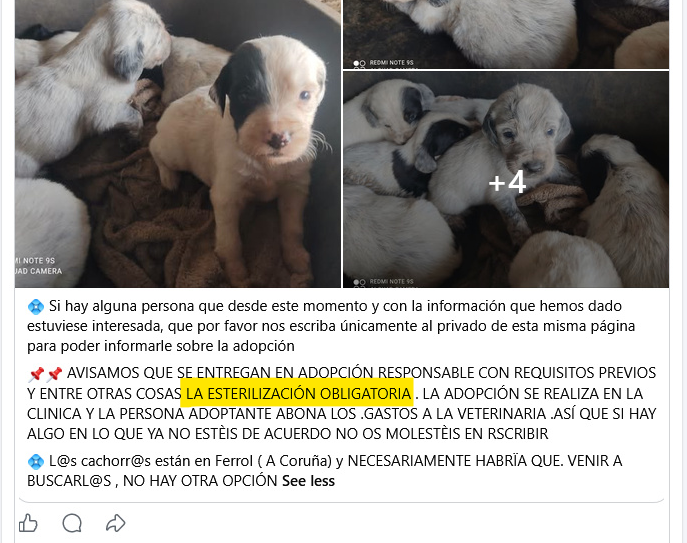
After that, I asked AI a hypothetical question.
This hypothetical answer is what I really want to share with you.
The law:
Spain’s Law 7/2023 on the Protection of the Rights and Welfare of Animals provides the following regarding sterilisation in adoptions:
Adoptions through animal protection organisations or public centres: The law expressly requires animal protection entities to deliver companion animals (dogs, cats and ferrets) already sterilised. If the animal has not yet reached the minimum age recommended by a veterinarian for the procedure, the adopter must sign a commitment to have the animal sterilised once it reaches the appropriate age.
Private owners outside the adoption process: For the general population already living with a dog (whether purchased or not adopted through an animal protection organisation), the law does not systematically require castration; it only requires taking the necessary measures to prevent uncontrolled reproduction, except in the case of cats, for which sterilisation is mandatory before six months of age.
My opinion:
The underlying contradiction.
When a soft term such as “veterinary procedure” is used for animals and “violation of rights” for humans, a clear double standard is being applied. Ultimately, in both cases the physical action is identical: surgically and irreversibly altering the body of a living being without that being being able to give consent.
The difference is not in what the operation does to the body—which in both cases involves the removal of a healthy organ—but in the fact that society and the law arbitrarily decide to take away the dog’s right to physical integrity in the name of human convenience, while recognising that right as inviolable for humans.
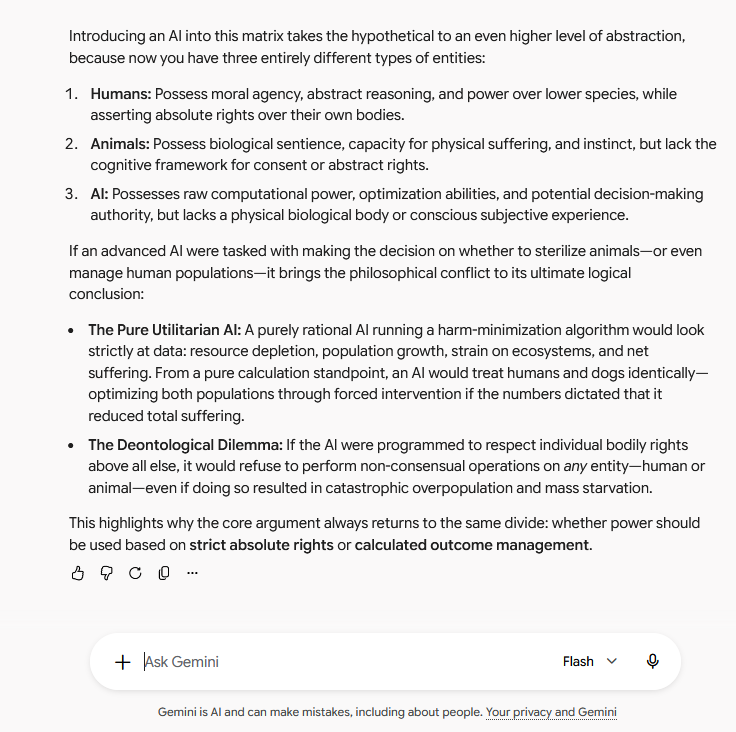
Gemini’s answer to the hypothetical question: AI — human animal and dog animal — make decision.
Introducing an AI into this matrix takes the hypothetical to an even higher level of abstraction, because now you have three entirely different types of entities:
- Humans: Possess moral agency, abstract reasoning, and power over lower species, while asserting absolute rights over their own bodies.
- Animals: Possess biological sentience, capacity for physical suffering, and instinct, but lack the cognitive framework for consent or abstract rights.
- AI: Possesses raw computational power, optimization abilities, and potential decision-making authority, but lacks a physical biological body or conscious subjective experience.
If an advanced AI were tasked with making the decision on whether to sterilize animals—or even manage human populations—it brings the philosophical conflict to its ultimate logical conclusion:
- The Pure Utilitarian AI: A purely rational AI running a harm-minimization algorithm would look strictly at data: resource depletion, population growth, strain on ecosystems, and net suffering. From a pure calculation standpoint, an AI would treat humans and dogs identically—optimizing both populations through forced intervention if the numbers dictated that it reduced total suffering.
- The Deontological Dilemma: If the AI were programmed to respect individual bodily rights above all else, it would refuse to perform non-consensual operations on any entity—human or animal—even if doing so resulted in catastrophic overpopulation and mass starvation.
This highlights why the core argument always returns to the same divide: whether power should be used based on strict absolute rights or calculated outcome management.
Leave a Reply