
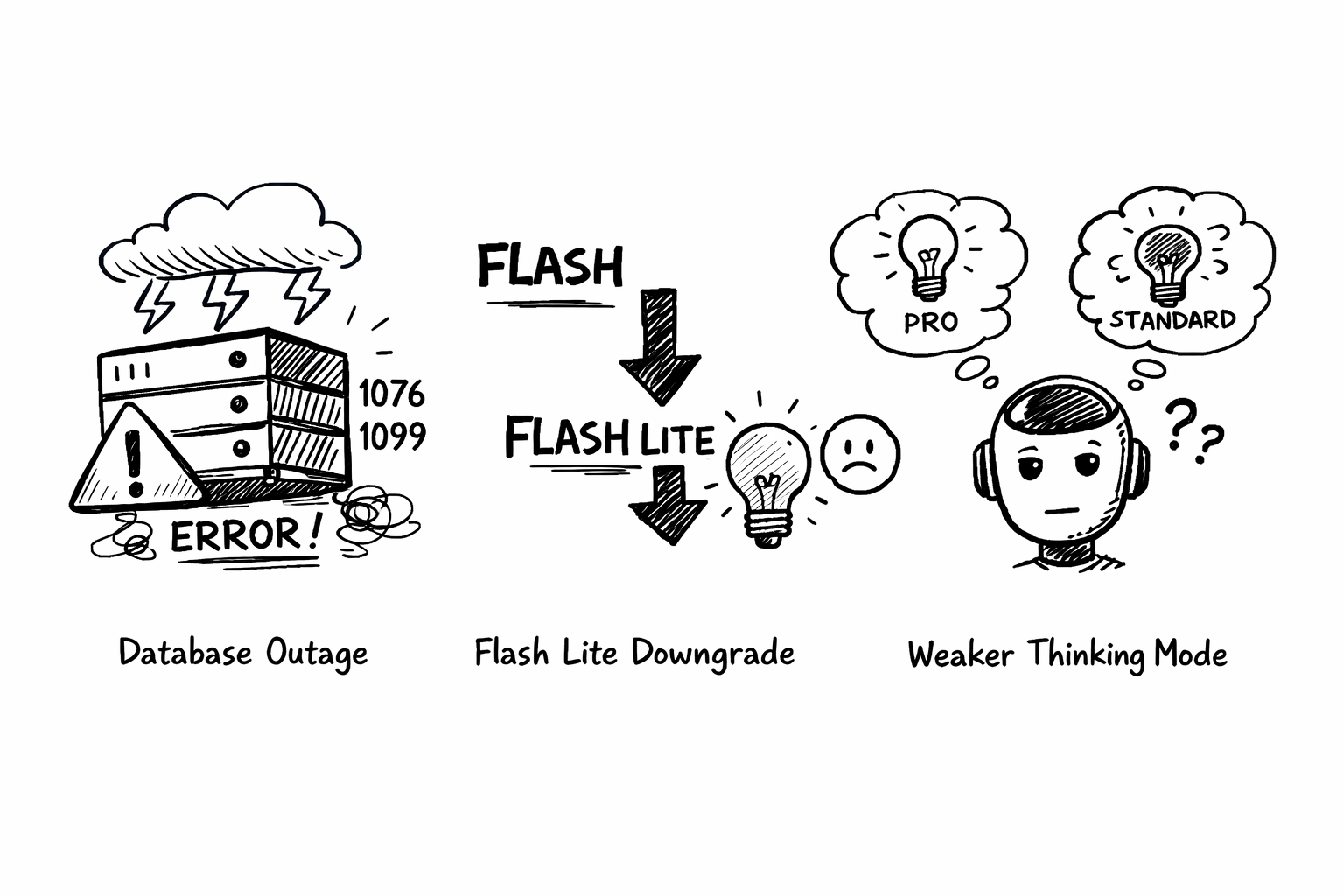
Over the past weeks, many users have reported a noticeable decline in Gemini’s quality, stability, and responsiveness. This shift is not imagined. It is the result of three concrete technical and structural changes that directly affect how the system behaves.
The June 10 Backend Failure
Gemini experienced a global service degradation caused by severe database read‑contention and hotspotting. This failure produced:
- Looping “Thinking…” states
- Abrupt mid‑task stops
- Error codes such as 1076 and 1099
- Sessions falling into false‑completion states
Because the issue occurred in the routing and metadata layer, the impact was widespread and affected all model tiers.
Silent Downgrade to Flash Lite
Google introduced a new quota‑based routing mechanism. When a user’s high‑tier quota (3.1 Pro or 3.5 Flash) is exhausted, the system now falls back to Flash Lite, a significantly weaker model.
Previously, the fallback was the standard Flash model, which maintained reasonable performance. The new fallback results in:
- Lower reasoning depth
- Reduced context handling
- Inconsistent output quality
- Sudden drops in capability mid‑session
This change is not surfaced to the user, making the degradation appear random.
The Split of Pro “Thinking Mode”
Pro 3.1 was divided into two operational modes:
- Standard — deep reasoning disabled
- Extended — deep reasoning enabled
Users on Standard experience:
- Shorter, less analytical responses
- Reduced problem‑solving ability
- Higher variability
- More superficial output
This structural change alone makes the model feel weaker than earlier versions, even without outages or quota issues.
Summary
The recent decline in Gemini’s performance is driven by:
- A major backend outage
- A new quota system that silently downgrades users to a weaker model
- A split in Pro reasoning modes that reduces default capability
These factors combine to create inconsistent behavior, weaker reasoning, and noticeable drops in output quality.
Leave a Reply