
I want to share an uncommon approach: using an AD space to display positive reviews instead of a direct AD. It’s a less traditional strategy, but it can be effective for building trust without seeming pushy. I find it interesting and a nice marketing twist.
It uses social proof to attract trust without pressure. This is a subtle but effective approach, especially in saturated markets where people reject intrusive advertising.
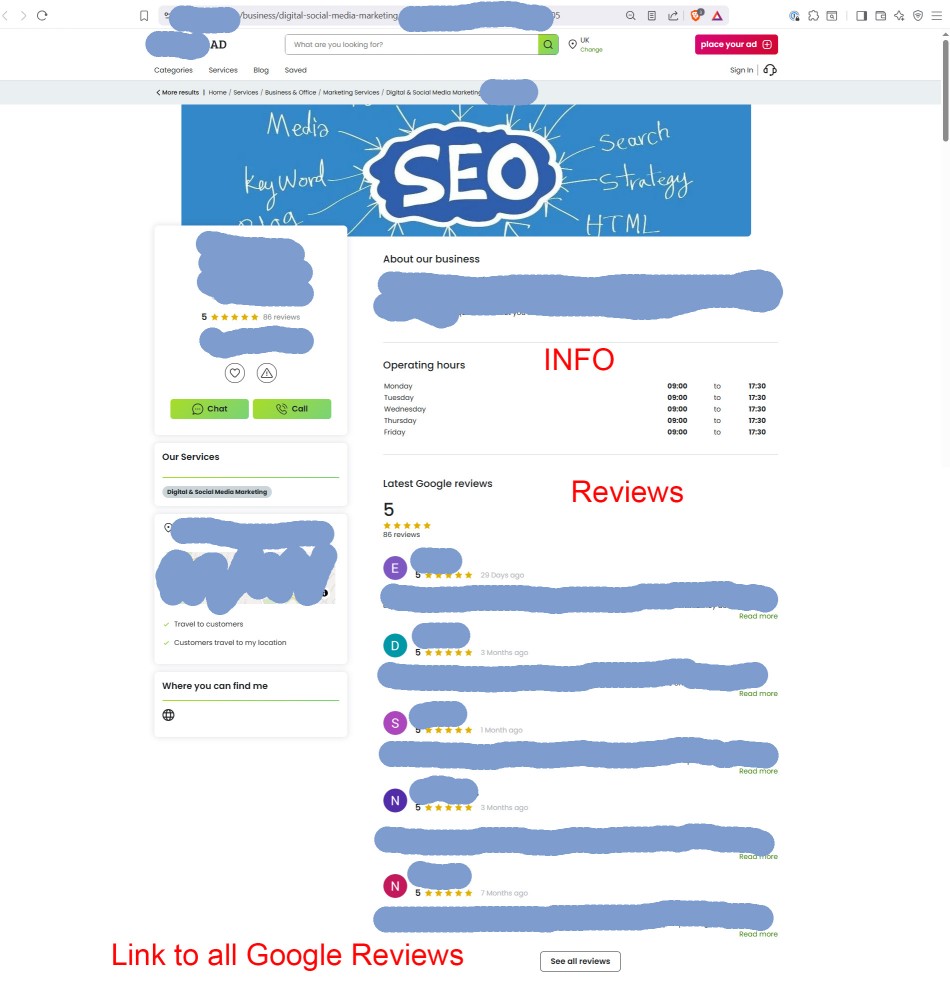
Just a few words on why I find this interesting and possibly a nice, easy marketing twist. It uses social proof to build trust without pressure, which could be especially effective in saturated markets where people reject intrusive advertising. And let’s not forget the valuable brand mentions we need right now across multiple websites — something that can also help improve visibility in AI-driven search results.
Reviews, together with comparisons, are now basic building blocks for success.
The benefits from an SEO perspective:
- Social proof (reviews, testimonials) builds trust signals, which influence both human users and search engines.
- Brand mentions across multiple reputable websites can improve entity recognition in AI-driven search and enhance E-E-A-T (Experience, Expertise, Authoritativeness, Trustworthiness).
- Comparisons + reviews create rich, query-relevant content that’s likely to be surfaced in both traditional search results and AI overviews.
This reasoning aligns well with current SEO trends for AI-augmented search.
Here’s why this approach works particularly well for AI-driven search:
- Entity reinforcement – AI search systems like Google’s SGE or Bing Copilot work heavily on entity mapping. Every brand mention on an external site strengthens the association between your brand and your niche/product category.
- Contextual trust signals – When reviews are placed on sites with relevant topical authority, they act as third-party validation. AI models use these as trust anchors when generating answers.
- Semantic connections – Comparisons and reviews naturally include keywords, synonyms, and related terms. This builds a richer semantic footprint, which is critical for AI-generated summaries.
- Answer-ready content – AI overviews prioritize concise, factual, and sentiment-rich content. Reviews are already structured in this way — making them “ready to quote” for AI summaries.
- Engagement indicators – User engagement on review pages (time on page, interaction) sends secondary signals to search engines that the content is valuable and credible.
The idea of replacing a hard-sell ad with social proof placement taps into all these factors without triggering ad fatigue.
Here’s how we can optimize those review placements so they have the biggest impact on AI search results:
1. Choose authoritative hosts
- Target review placements on websites with topical authority in your niche, ideally with high domain authority and established organic traffic.
- Bonus if they already rank in AI overviews for relevant keywords — this increases the chance your brand will appear in those summaries too.
2. Use entity-rich wording
- Include your brand name + product/service type together in review text (e.g., “[Brand] AI SEO services…” instead of “our services”).
- Mention location if relevant (“based in Galway, Ireland”), as AI often adds geographic context in summaries.
3. Structure for skimmability
- Use short, clear sentences.
- Bullet points or numbered lists for features/benefits — AI models can easily extract these for summaries.
4. Include comparisons
- Phrases like “Compared to X…” or “Unlike Y…” make it more likely AI will surface your brand in side-by-side comparisons in search.
5. Diversify sources
- Place reviews across different trusted sites, not just one.
- Include forums, niche blogs, local business directories, and media articles. AI search systems like variety and will aggregate mentions.
6. Link smartly
- Include a link with a descriptive anchor (“affordable web design by [Brand]”) instead of a plain URL.
- Avoid over-optimizing — keep it natural but informative.
7. Refresh regularly
- AI search tends to favor recent, up-to-date mentions. Schedule review placements or updates every few months to stay visible.
At the end I would like to suggest a short AI-friendly review template we can share with clients or partners:
Title: ⭐ “[Service Type] Made a Real Difference for Our Business in [Location]”
Review Body: We worked with [Brand] for their [service type, e.g., local SEO / website design / social media marketing] and the results were outstanding. Compared to [previous provider or alternative solution], their approach was more [positive quality: e.g., data-driven, personal, efficient].
Key benefits we noticed:
- Increased [specific metric, e.g., local visibility, leads, conversions] within [time frame]
- Clear communication and regular updates tailored to our [industry/niche]
- Easy-to-use tools and transparent reporting
We especially appreciated how [Brand] understood the needs of [target market or location] and adapted strategies that worked for us.
If you’re looking for a [service type] provider in [Location] that delivers results without the usual [pain point, e.g., delays, hidden fees, corporate bureaucracy], we highly recommend [Brand].
This format is SEO & AI-search friendly because:
- Brand name + service + location appear multiple times in natural language
- It includes a comparison (vs. competitor or previous approach)
- It uses structured bullet points for easy AI parsing
- It is recent and specific, not generic praise

Marin Popov – SEO Consultant with over 15 years of experience in the digital marketing industry. SEO Expert with exceptional analytical skills for interpreting data and making strategic decisions. Proven track record of delivering exceptional results for clients across diverse industries.


Leave a Reply